
The Flying Tesla Roadster Explained: SpaceX Cold-Gas Thrusters, 0.81s Acceleration & 2028 Production Specs
Published on October 17th, 2026
AI Summary
This is an AI-generated summary for the article titled "The Flying Tesla Roadster Explained: SpaceX Cold-Gas Thrusters, 0.81s Acceleration & 2028 Production Specs". The content covers several key points including the main subject, its implications, and future outlook. The AI has analyzed the text to provide this concise overview to help you quickly grasp the core message of the report. This summary aims to be accurate and neutral.
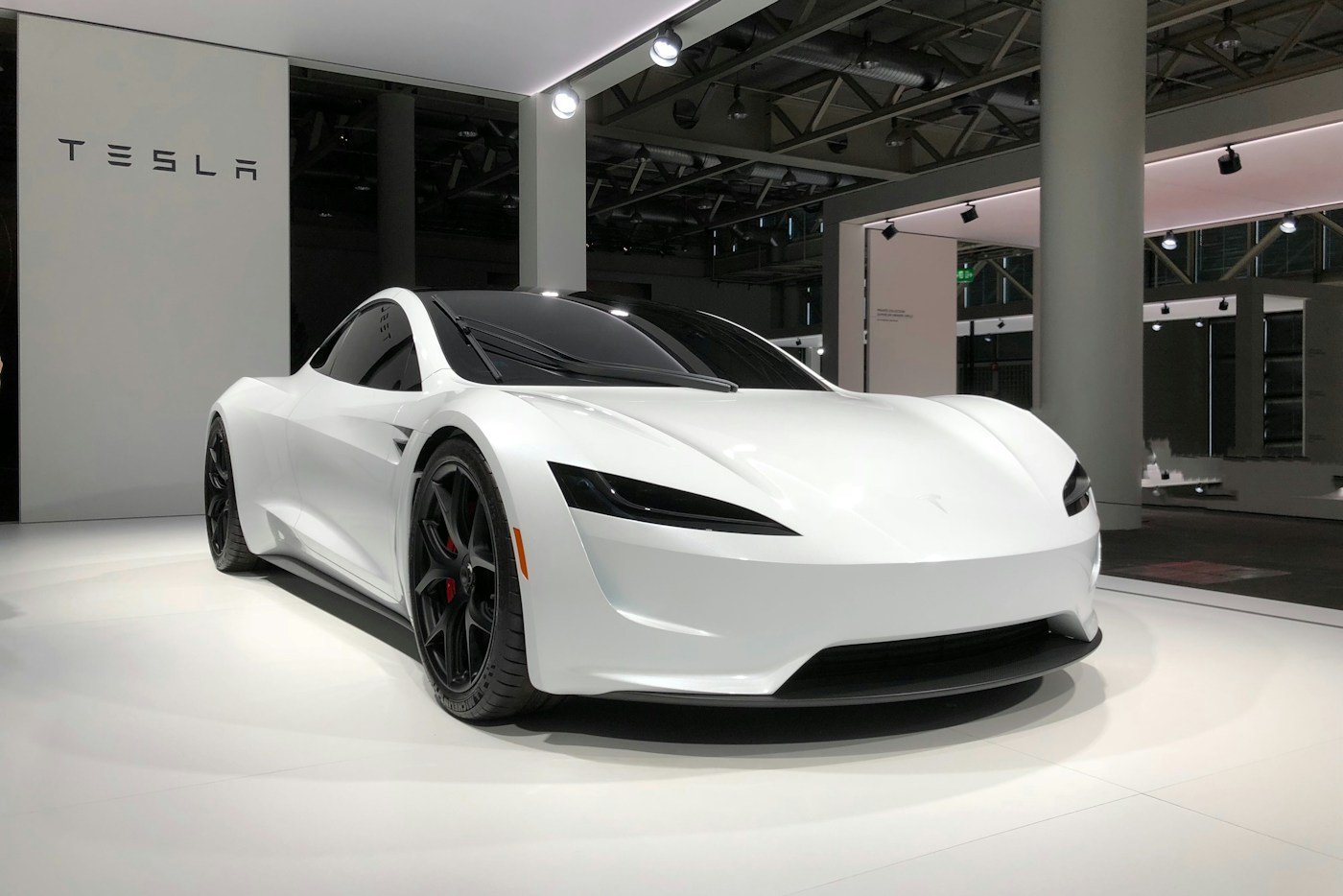
What if a production car could accelerate from 0 to 60 mph in less than a second, leap over road obstacles, and literally drive upside down on an inverted track? What once sounded like pure science fiction has officially become engineering reality following the dramatic unveiling of the production-intent Second-Generation Tesla Roadster equipped with the specialized SpaceX Rocket Package.
Demonstrated live at the SpaceX rocket development facility in McGregor, Texas, the new Tesla Roadster blurs the line between an all-electric hypercar and a ground-level spacecraft. By combining ultra-high-pressure cold-gas thrusters derived from Falcon 9 rocket hardware with an active underbody vacuum fan system, Tesla has engineered a machine that rewrites the fundamental limits of tire traction, aerodynamics, and automotive physics.
1. From the 2017 Concept to the Finalized 2028 Production Reality
The journey of the second-generation Tesla Roadster has been one of the most closely watched sagas in modern automotive history. Originally unveiled in November 2017 as a surprise finale to the Tesla Semi event, the sleek prototype was initially targeted for a 2020 release with a promised 1.9-second 0-to-60 mph sprint.
Over the years that followed, however, the program experienced repeated delays. Behind the scenes, three major factors drove the extended timeline:
- Battery Cell & Powertrain Maturation: Tesla prioritized scaling high-volume global programs—including the Model Y, high-density battery cells, and the stainless-steel Cybertruck—before committing manufacturing capacity to a low-volume halo hypercar.
- Complete Structural Re-Engineering: Rather than releasing a conventional electric sports car, engineering teams completely redesigned the Roadster chassis from the ground up to house composite high-pressure aerospace gas vessels and active ground-effect suction turbines.
- SpaceX Propulsion Integration: Integrating rocket-grade cold-gas attitude control nozzles into an automotive crash structure required years of custom actuation, thermal, and aerodynamic testing.
With the production-intent engineering now demonstrated in Texas, Tesla has officially locked in the manufacturing roadmap: series production of the new Tesla Roadster is slated to begin in 2028.
2. Deep Dive: How Does the Flying Tesla Roadster Actually Work?
Despite viral headlines calling it a "flying car," the new Tesla Roadster is not a quadcopter drone or a vertical-takeoff aircraft built for commuting at 5,000 feet. Instead, it is a ground-based hypercar that uses aerospace thrust vectoring and active vacuum aerodynamics to perform controlled airborne maneuvers—including short-duration hovering, high-speed leaps over obstacles, and mid-air attitude stabilization.
SpaceX Cold-Gas Thrusters (Zero Fire, Pure Compressed Air)
In a conventional supercar, acceleration and braking are strictly limited by the friction between rubber tires and asphalt. Once the tires lose grip, adding more electric horsepower simply results in wheelspin. Tesla bypassed the tire-traction limit entirely by installing up to 10 strategically positioned SpaceX cold-gas rocket nozzles around the perimeter of the vehicle.
Crucially, there is no combustion, fire, or liquid rocket fuel involved. The system operates entirely on ultra-high-pressure compressed air stored at approximately 5,500 psi inside aerospace-grade Carbon Fiber Overwrapped Pressure Vessels (COPVs)—the exact same tank technology used inside SpaceX orbital rockets. Ultra-fast electric actuators open and vector the nozzles within milliseconds, blasting supersonic jets of compressed air to push the car forward, press it into corners, brake with violent deceleration, or lift the chassis momentarily into the air.
Self-Sustaining Electric Air Compressor System
One of the most ingenious aspects of the SpaceX package is that owners never need to visit a specialized propellant station to refill the gas tanks. The Roadster uses energy from its massive main electric battery pack to power heavy-duty onboard electric air compressors. As you drive normally, these compressors draw in ambient outside air and pump it back into the 600-liter composite pressure tanks, making the thruster system completely self-sustaining.
Multi-Mode Underbody Suction Fans: Driving Upside Down
At speeds approaching 230 mph, aerodynamic lift is a hypercar's worst enemy—air rushing beneath the chassis wants to flip the vehicle airborne. To solve this, Tesla engineered a multi-mode underbody suction fan and active ground-sealing skirt system.
By actively evacuating the air from beneath the floorpan, the turbine fans create a powerful partial vacuum that pulls the car downward with up to 2Gs of suction force—even when the vehicle is at a complete standstill. Because this downforce exceeds the force of Earth's gravity (1G), the Roadster can literally seal itself to an inverted ceiling track and drive upside down, while also unlocking ferocious cornering grip and immediate launch traction on standard pavement.
3. The Three Tesla Roadster Variants Explained
To separate road-legal supercar buyers from extreme track-only collectors, Tesla has structured the second-generation Roadster lineup into three distinct engineering tiers:
| Specification / Feature | 1. Performance Model | 2. Thrust Model | 3. Rocket Model |
|---|---|---|---|
| Primary Focus | Road-Ready Pure EV Hypercar | Race-Ready Thruster Track Car | Air-Ready Flight & Stunt Hypercar |
| 0–60 MPH Acceleration | Under 1.6 Seconds | Under 0.9 Seconds (0.81s Demo) | Under 0.59 Seconds |
| Seating Layout | 2 Seats | 2 Seats | 1 Driver Seat (Rear/Side Air Tanks) |
| Underbody Suction Fans | Included (Multi-Mode Active) | Included (2G Ground Suction) | Included (Full Vacuum Seal) |
| SpaceX Cold-Gas Thrusters | None (Pure Electric Drive) | Rear-Mounted Propulsion Thrusters | 10 Perimeter Nozzles (3D Flight Control) |
| Public Road Legal Status | Street Legal | Street Legal (Thrusters Track-Locked) | Track & Closed-Course Only (Invite-Only) |
1. The Performance Model (Baseline Electric Supercar)
The entry point to the Roadster lineup is a pure-electric, two-seat hypercar with no compressed-gas rocket nozzles. Even without thrusters, its electric drivetrain and active underbody suction fans launch it from 0 to 60 mph in under 1.6 seconds—already faster than almost every production car on Earth.
2. The Thrust Model (Rear Rocket Boost & 2G Downforce)
Stepping up to the Thrust variant pairs the active underbody vacuum fan system and aerodynamic sealing skirts with rear-mounted SpaceX cold-gas thrusters. Built for relentless track grip and straight-line dominance, this configuration drops the 0-to-60 mph sprint below 0.9 seconds, having clocked an official 0.81-second run during live testing.
3. The Rocket Model (The Ultimate "Flying" Variant)
At the pinnacle sits the invite-only Rocket Model. In this configuration, additional passenger seating is removed altogether to accommodate the full 600-liter array of 5,500 psi carbon-fiber composite air tanks. Equipped with 10 perimeter thrusters pointing forward, backward, laterally, and downward, the Rocket Model can execute short controlled hops over obstacles, hover briefly above the ground, and blast from 0 to 60 mph in an astonishing 0.59 seconds.
4. Breaking the Laws of Physics: The Key Numbers
- 0 to 60 MPH in 0.81 Seconds (0.59s Max Rocket Mode): For perspective, a modern Formula 1 car takes roughly 2.4 to 2.6 seconds to reach 60 mph. By combining 2Gs of fan suction with rocket thrust, the Roadster accelerates three to four times quicker than a Grand Prix racer.
- 230+ MPH (370+ km/h) Top Speed: Active aerodynamic surfaces adjust continuously at high velocity to minimize drag while maintaining high-speed stability.
- 300+ Miles (480+ km) Electric Range: When the compressors and thrusters are disengaged for normal highway cruising, the high-density battery pack delivers over 300 miles of real-world driving range on a single charge.
5. The Catch: The "Not Street Legal" Controversy
While the engineering spectacle of a jumping, hovering Tesla has captivated the automotive world, it comes with a major regulatory catch: the full-flight Rocket variant is not street legal for public road use.
The reason comes down to basic physics and public safety. Discharging compressed air at 5,500 psi through rocket nozzles generates an explosive acoustic shockwave and a supersonic jet blast capable of shattering nearby windshields, flinging road debris like shrapnel, damaging trailing vehicles, or severely injuring pedestrians on a city street. Consequently, full thruster and flight modes are strictly restricted to closed private circuits and sanctioned racetracks.
Securing one is equally exclusive. While the standard Performance Roadster can be reserved with a $50,000 deposit (and $250,000 for the Thrust tier), the top-spec Rocket Model is available strictly by invitation only and commands a price tag running into several hundred thousand dollars.
6. Conclusion: The Final Human-Driven Halo Car
Beyond its mind-bending 0.81-second acceleration runs and SpaceX cold-gas thrusters, the second-generation Tesla Roadster represents the end of an era. As Elon Musk has emphasized, this hypercar is designed to be the ultimate crowning achievement—and likely the final vehicle Tesla ever builds specifically for manual human driving—before the company shifts its entire future lineup toward full autonomy and dedicated Robotaxis.
By fusing orbital aerospace engineering with electric hypercar performance, the 2028 Tesla Roadster stands as one of the boldest machines ever conceived on four wheels.